
What are general terms and conditions?
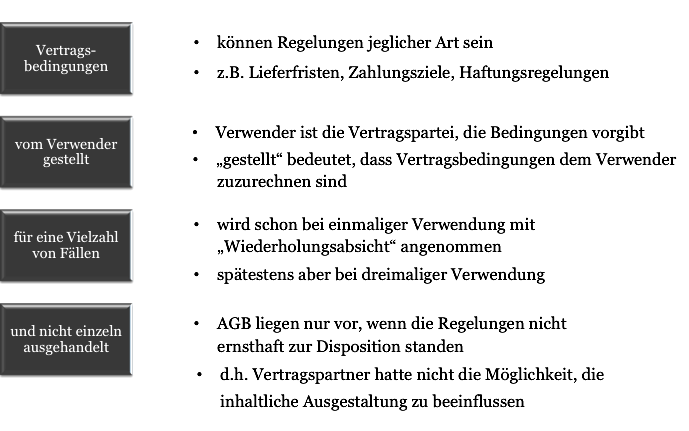
Sections 305 et seq. of the German Civil Code (BGB) contain regulations on general terms and conditions:
In detail:
Why General Terms and Conditions?
AGB are mainly used for the following reasons:
- Simplification of the business process (e.g. reduction of the time required to negotiate the contract)
- GTC create uniform and detailed regulations for legal relationships in mass contracts (simplification of legal transactions)
- make it possible to further develop inappropriate laws through new regulations or to concretize undefined legal terms (e.g. if the law states a "reasonable" period, this can be precisely defined in the GTC)
- Often even indispensable if there are no statutory regulations for the type of contract
- Strengthen your own legal position in relation to the respective contractual partner
Inclusion of general terms and conditions
In order to be effective at all, general terms and conditions must be effectively included in a contractual relationship:

Limits of admissibility (content control) of general terms and conditions
The user cannot make unlimited provisions (in his favor) in the GTC. The law provides for very specific prohibitions of regulation in this regard, particularly when used in relation to consumers. However, T&Cs between entrepreneurs are also subject to a so-called content review, in particular the prohibition of unreasonable disadvantage to the contractual partner also applies here. The following chart provides an overview:
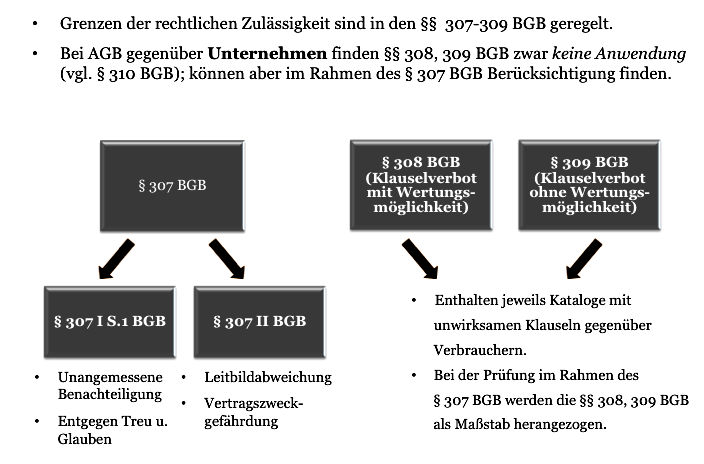
Accordingly, the following principles in particular apply to the limits of the admissibility of GTC:
§ Section 307 I sentence 2 BGB Transparency requirement
= According to this, an unreasonable disadvantage to the customer can also result from the fact that a GTC clause is not clear and comprehensible
§ 305 c BGB surprising clauses
= GTC clauses are not part of the contract if they are "so unusual that the user's contractual partner need not expect them"
§ 305 b BGB individual contractual agreements take precedence over the GTC
= Individual agreements between the parties shall always take precedence. GTCs that conflict with such individual agreements have no effect.
Conflict of general terms and conditions
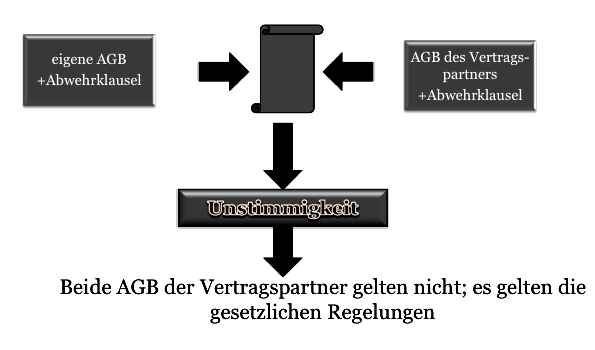
In business transactions between entrepreneurs, it is more the rule than the exception that both parties attempt to make their respective GTCs an integral part of the contract. The question then arises, particularly in the event of conflicting provisions, as to what should then apply. The following diagram illustrates the case where neither party has considered the possibility of such a conflict in their respective GTCs:
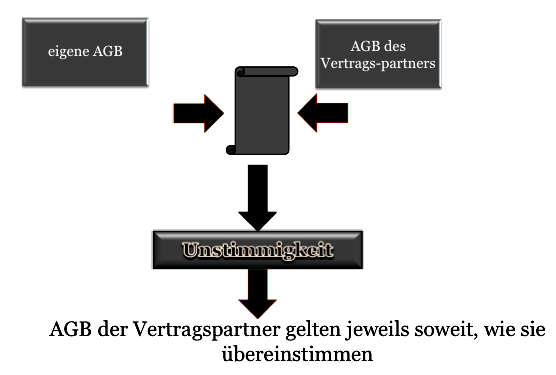
The situation is different if so-called defense clauses are used:
Defense clause: "These General Terms and Conditions of Purchase (Terms and Conditions of Purchase) shall apply exclusively; deviating, conflicting or supplementary General Terms and Conditions of the Supplier shall only become part of the contract if and to the extent that the Purchaser has expressly agreed to their validity in writing. This requirement of consent shall also apply if the Purchaser accepts the Supplier's services without reservation in the knowledge of the Supplier's General Terms and Conditions of Business ."
In the event that one or both parties have included a so-called defense clause in their GTC, the following applies:
Variant 1 (one party has included a defense clause)
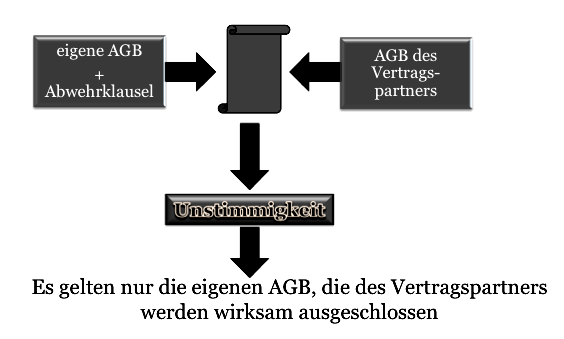
Variant 2 (both parties have included a defense clause)